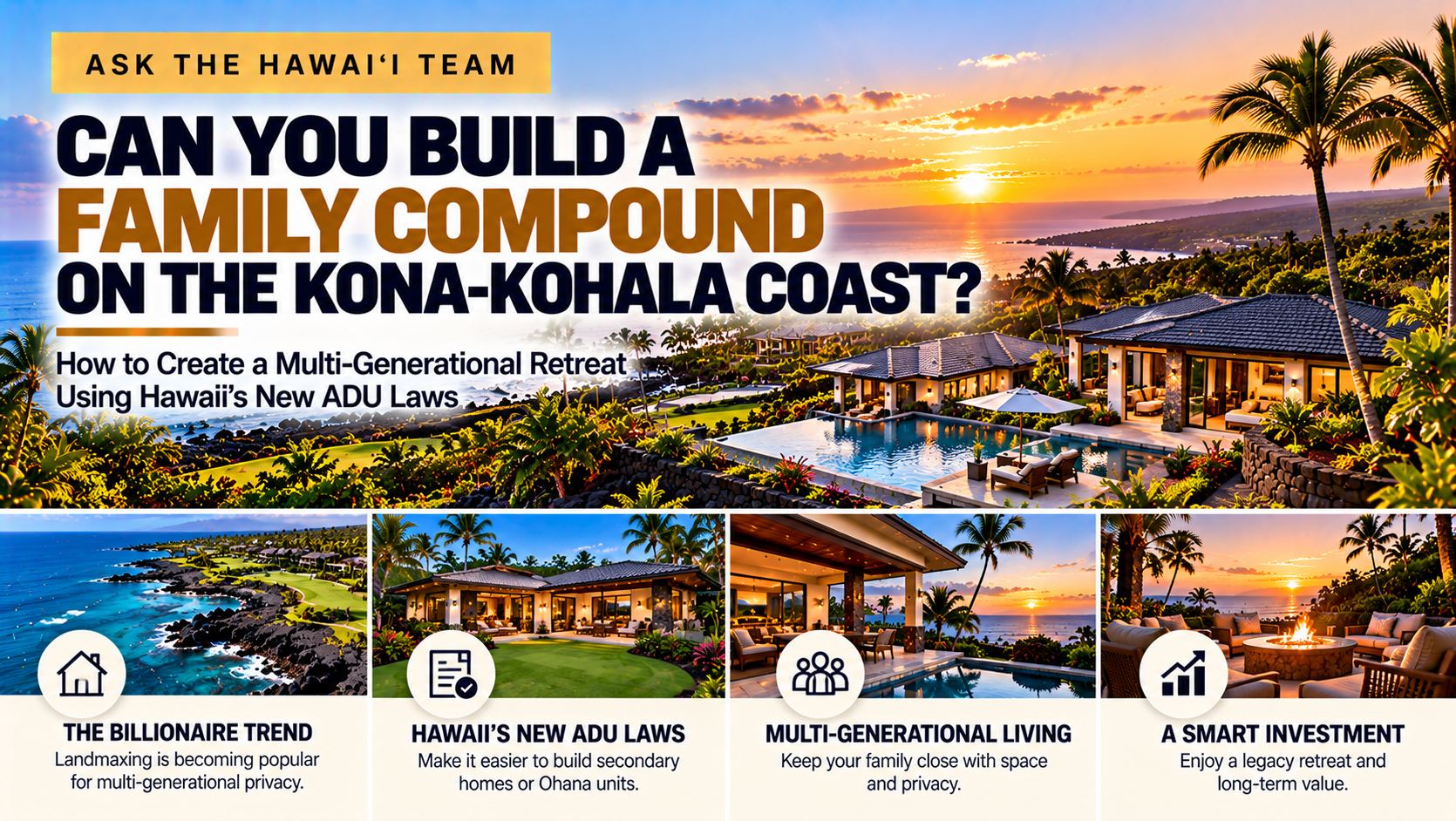
Quick Answer: While billionaires like Jeff Bezos and Ken Griffin drop hundreds of millions on contiguous estates in Florida, you can achieve a similar multi-generational family compound on the Kona-Kohala Coast for a fraction of the cost. By leveraging Hawaii’s updated ADU laws and prime resort land in areas like Hualālai or Mauna Lani, buyers are successfully creating shared family sanctuaries without a $450M price tag.
Key Takeaways: The Evolution of Family Compounds
- The Billionaire Trend: Ultra-wealthy buyers are “landmaxing” by snapping up contiguous parcels to secure multi-generational privacy.
- Hawaii’s New Rules: Recent local ADU (Accessory Dwelling Unit) legislation makes building secondary or multi-home setups on a single lot much more achievable.
- Resort Opportunities: Exclusive Kona-Kohala Coast enclaves offer the space and infrastructure needed for cohesive family compounds.
- Balanced Investment: A multi-unit family purchase can double as a powerful long-term asset and a legacy vacation home.
As buyers look beyond mainland estates toward Hawaii, the concept of “landmaxing” has evolved from a billionaire headline into an attainable strategy for families. Here is a breakdown of how you can build your own multi-generational compound on the Kona-Kohala Coast using local real estate rules and smart purchasing strategies.
What Is “Landmaxing” and How Can I Apply It to a Kona-Kohala Coast Second Home?
Landmaxing is the latest real estate buzzword describing the strategic acquisition of land and adjacent properties to build expansive, private family compounds. On the mainland, media moguls spend upwards of $450 million accumulating massive acreage. More often than not, buyers assume this level of estate consolidation is reserved exclusively for the ultra-elite. However, on the Kona-Kohala Coast, you can apply this exact strategy on a smarter, scaled-down footprint without liquidating a corporate empire.
When searching for a second home or vacation rental property here, landmaxing translates to identifying oversized resort lots or paired parcels that allow your extended family to live close together yet maintain individual privacy. It is simply economics: pooling resources across generations lets you secure valuable Big Island land that appreciates over time. I would not be surprised to see more families adopting this model to bypass traditional condo living in favor of legacy compounds that shelter multiple generations under the Hawaiian sun.
How Do Hawaii’s New ADU Laws Affect Building a Multi-Generational Family Compound in Kona?
Building a multi-generational sanctuary has historically faced rigid zoning bottlenecks, but recent legislative shifts regarding Accessory Dwelling Units (ADUs) have completely changed the landscape across Hawaii County. These updated municipal rules now make it far more realistic to construct secondary Ohana dwellings or detached guest suites on qualifying residential parcels along the Kona-Kohala Coast. Instead of purchasing multiple separate properties at peak market rates, families can maximize a single lot’s density legally and efficiently.
For instance, an oversized parcel in an eligible zoning district can often accommodate a main plantation-style home alongside a permitted detached cottage, perfectly mirroring historical multi-generational living arrangements where grandparents, parents, and children shared daily life. More often than not, utilizing these local zoning provisions saves buyers millions in acquisition costs compared to assembling massive contiguous mainland acreage. I would not be surprised to see county guidelines continue favoring smart infill development to support local multi-generational housing needs. It is simply economics that supports building vertically or adjacently on a single tax parcel rather than buying up entire zip codes.
Should I Buy Contiguous Lots or a Single Large Estate on the Kona-Kohala Coast?
Deciding whether to acquire adjacent parcels or focus on a single expansive estate depends entirely on your family’s long-term utilization goals and privacy requirements. Purchasing two side-by-side properties grants ultimate physical separation—allowing grandparents to reside in a peaceful single-story residence while younger family members occupy a dynamic vacation rental nearby. Conversely, acquiring a single, ultra-prime acreage estate within a gated enclave offers pre-established security and unified architectural landscaping right out of the gate.
Along the Kona-Kohala Coast, inventory for contiguous lots is fiercely competitive, making strategic planning essential. More often than not, securing a primary parcel with expansion potential or partnering to buy adjacent properties creates a resilient asset. I would not be surprised to see buyers prioritize multi-acre resort parcels that inherently offer buffer zones without needing formal lot-line adjustments. It is simply economics of scale; managing a single large estate often incurs lower association dues and streamlined maintenance compared to juggling distinct utility services across separate boundary lines.
How Much Will It Cost to Build a Multi-Home Family Compound in Resorts Like Kukio or Hualalai?
While Florida billionaires spend upwards of $230M to $450M assembling coastal compounds, a world-class family sanctuary on the Kona-Kohala Coast requires a much more grounded financial footprint. Ultra-exclusive enclaves like Hualālai or Kukio feature custom home sites and estates where entering the market starts around $5 million to $15 million for land and existing structures, with custom compound builds scaling upward based on square footage.
When you factor in architectural design, sustainable solar integration, and premium indoor-outdoor lanais suited for multi-generational gatherings, a comprehensive compound build can easily range from $10 million to $25 million total. More often than not, this investment delivers an irreplaceable legacy asset that far outperforms a standard luxury condo. I would not be surprised to see these gated resort properties appreciate aggressively as mainland wealth continues migrating toward Big Island sanctuaries. It is simply economics: finite resort acreage paired with multi-generational demand creates a high-barrier-to-entry market that protects your family’s capital for decades.
Is Landmaxing on the Kona-Kohala Coast a Smart Financial Investment for My Family?
Approaching a multi-generational purchase through the lens of landmaxing transforms a standard second home into a powerful, multi-purpose financial engine. Beyond serving as a cherished gathering place for holidays and extended stays, a multi-unit compound on the Kona-Kohala Coast can often integrate legally compliant vacation rental operations to offset holding costs when family isn’t in residence.
Diversifying your real estate portfolio with high-demand Big Island dirt safeguards against mainland economic volatility. More often than not, legacy properties within premier resort corridors retain their intrinsic value through economic cycles due to strict master-planned caps on development. I would not be surprised to see family compounds become the ultimate wealth-preservation vehicle for affluent buyers seeking both lifestyle utility and generational security. It is simply economics: combining family utility with high-end asset appreciation yields dividends that pure financial instruments simply cannot match.
The Bottom Line: Secure Your Legacy on the Kona-Kohala Coast Today
Building a multi-generational family compound on the Kona-Kohala Coast allows you to capture the spirit of billionaire landmaxing at a realistic scale. By combining modern ADU flexibilities, prime resort infrastructure, and strategic property selection, your family can create a timeless island sanctuary.
“Landmaxing isn’t just about the square footage you own; it’s about the generations of memories you secure in a place as timeless as the Kona-Kohala Coast.” — Dan Polimino
Frequently Asked Questions
Q: What are the current rules for building ADUs on residential land along the Kona-Kohala Coast? A: Hawaii County guidelines generally permit Accessory Dwelling Units (ADUs) or Ohana units on specific residential and agricultural parcels, typically ranging up to 800–900 square feet depending on lot size and zoning classification. Compliance requires adhering to local wastewater capacity rules, setback minimums, and proper permitting through the county planning department.
Q: Which Kona-Kohala Coast resorts allow multiple structures or guest Ohanas on a single parcel? A: Exclusive residential enclaves such as Hualālai, Kukio, and parts of Mauna Lani often permit main residences paired with approved detached guest hales or Ohana pavilions. However, every resort has strict internal design guidelines and architectural review committees that must approve secondary structures before construction begins.
Q: How does landmaxing differ from buying a traditional luxury vacation rental in Hawaii? A: While a traditional vacation rental is typically purchased as a single, standalone income-producing asset, landmaxing focuses on accumulating contiguous space or multi-unit flexibility designed explicitly for family co-habitation and long-term legacy preservation. It prioritizes generational privacy and footprint expansion over pure short-term rental yields.