Quick Answer: Owning a $20 million luxury vacation home in Kūkiʻo along the Kona-Kohala Coast incurs annual carrying and maintenance costs ranging from 2% to 4% of the home’s value. This translates to roughly $400,000 to $800,000 per year, covering property taxes, high-end insurance, exclusive club dues, HOA fees, and meticulous property upkeep.
Key Takeaways: Understanding Ownership Overhead
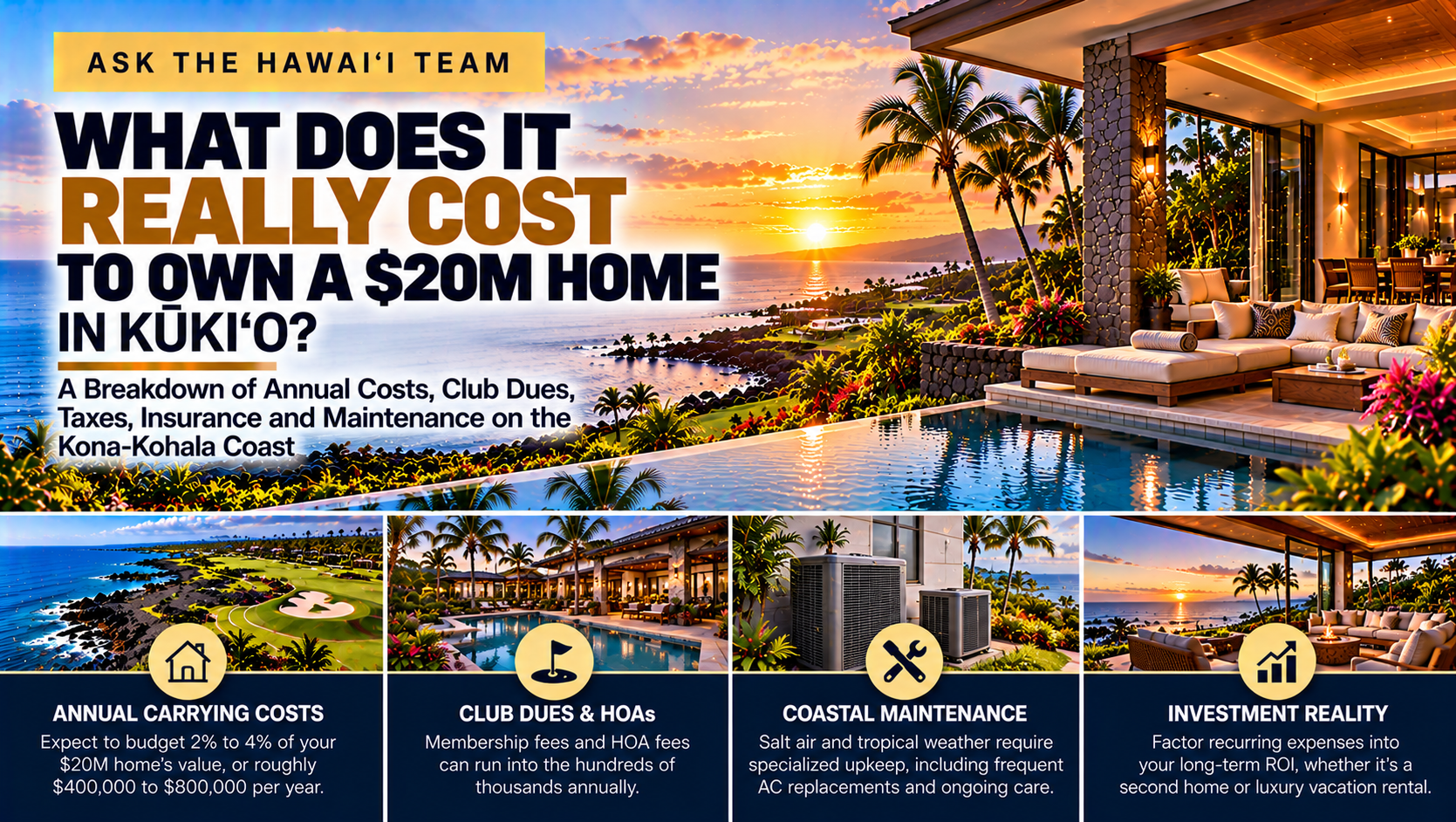
- Carrying Cost Rule: Expect to budget 2% to 4% of your $20 million home’s value annually for holding and maintenance expenses.
- Exclusive Club Dues: Membership fees for elite Kona-Kohala Coast communities like Kūkiʻo and Hualalai Resort significantly impact yearly overhead.
- Environment-Specific Upkeep: Coastal luxury vacation homes require specialized maintenance to combat ocean salt air and tropical weathering.
- Investment Reality: Buyers must factor these recurring expenses into their long-term ROI calculations before purchasing a second home.
Navigating the financial realities of owning ultra-luxury real estate on the Kona-Kohala Coast requires looking past the initial purchase price. Here are the core questions buyers and sellers are asking about the true cost of luxury ownership in Kūkiʻo.
How Much Does It Cost Annually to Maintain a $20M Second Home in Kūkiʻo?
When you step into the ultra-exclusive gates of Kūkiʻo on the Kona-Kohala Coast, the financial commitment extends far beyond the initial transaction. More often than not, buyers focus solely on the sticker price, forgetting that holding a multi-million-dollar asset requires a dedicated operational budget. We apply a reliable 2% to 4% carrying cost rule for properties in this bracket. For a $20 million estate, you should expect to spend between $400,000 and $500,000 annually on the lower end, scaling up to $800,000 or more if extensive estate management or major repairs are underway. This financial framework accounts for standard operational overhead plus heavy cyclical maintenance. It is simply economics that managing sprawling grounds, private pools, and sophisticated smart-home automation in a tropical resort environment demands a professional team. I would not be surprised to see second-home owners caught off guard if they fail to factor these recurring line items into their long-term wealth management strategy from day one.
What Are the Hidden Property Taxes and Insurance Costs for Luxury Vacation Homes on the Kona-Kohala Coast?
Operating a high-end vacation rental or private second home along the Kona-Kohala Coast brings distinct tax and liability obligations. Hawaii County property tax rates vary depending on how the property is classified—whether as a primary residence, standard second home, or short-term vacation rental. Beyond taxes, insuring a multi-million-dollar coastal property involves navigating strict underwriting requirements for windstorms, general liability, and high-value structures. More often than not, premiums climb steeply due to the marine environment and exposure to natural elements. It is simply economics that insurers charge higher premiums for luxury assets situated directly on the coastline. I would not be surprised to see annual insurance and tax bills alone consuming a substantial six-figure portion of your operational budget. Buyers must review these specific classifications with local experts early in the escrow process to avoid unwelcome financial surprises after closing.
Are Kūkiʻo Club Dues and HOA Fees Worth the Investment for Kona-Kohala Coast Buyers?
The lifestyle amenities that define Kūkiʻo and neighboring elite enclaves along the Kona-Kohala Coast require substantial collective funding through homeowners associations and private club dues. Membership initiation fees can easily reach several hundred thousand dollars, paired with steep monthly or annual dues that maintain world-class golf courses, private beach clubs, and 24-hour gated security. More often than not, buyers view these steep fees as an essential trade-off for unmatched privacy, pristine surroundings, and top-tier concierge services. It is simply economics that maintaining championship golf greens and private dining facilities demands significant capital from every property owner in the enclave. I would not be surprised to see prospective second-home owners reevaluating their choices if they do not plan to utilize these exclusive club privileges frequently enough to justify the recurring overhead costs.
How Does Salt Air Maintenance Impact the ROI of a Kona-Kohala Coast Luxury Vacation Home?
Owning real estate directly on the oceanfront or within close proximity to the water along the Kona-Kohala Coast introduces a relentless environmental challenge: salt air corrosion. Ocean breezes continuously attack metal fixtures, architectural elements, and mechanical systems. For instance, a typical $20 million estate might feature seven separate air conditioning condensing units and air handlers to cool expansive living pavilions. Because of the aggressive marine environment, these units deteriorate rapidly, forcing owners into frequent, costly replacements—often running around $16,000 a pop for specialized coastal-grade equipment. More often than not, deferred maintenance accelerates structural decay and erodes your net return on investment. It is simply economics that proactive preservation protects your asset’s long-term value. I would not be surprised to see unbudgeted mechanical failures derail a year’s projected rental or appreciation margins if regular preventative maintenance is neglected.
Should I Rent Out My Kūkiʻo Second Home to Offset High Annual Carrying Costs?
Offsetting the steep yearly expenses of a luxury vacation home through short-term rentals is a common strategy for many high-net-worth buyers. However, elite enclaves like Kūkiʻo maintain strict community rules, HOA guidelines, and minimum rental term restrictions designed to preserve neighborhood tranquility and privacy. More often than not, navigating these local covenants requires careful compliance with Hawaii’s General Excise Tax (GET) and transient accommodations rules. It is simply economics that generating rental income can help mitigate the 2% to 4% annual carrying costs, but it also introduces higher wear-and-tear on high-end finishes and custom furnishings. I would not be surprised to see owners balance their desire for rental revenue against the sheer peace of keeping their second home exclusively private for personal island getaways throughout the year.
The Bottom Line: Plan Your Kūkiʻo Investment Strategy with Dan Polimino
Mastering the financial landscape of the Kona-Kohala Coast requires expert guidance, a clear-eyed look at recurring carrying costs, and a strategy tailored to luxury island real estate. Whether you are buying or selling a premier estate in Kūkiʻo, understanding every facet of ownership ensures your investment remains a source of joy rather than a financial burden.
“In ultra-luxury real estate, success isn’t just about what you buy—it’s about understanding the true cost of keeping it.” — Dan Polimino
Frequently Asked Questions
Q: What are the typical HOA and club dues for ultra-luxury resorts like Kūkiʻo and Hualalai Resort? A: Annual club dues and resort association fees in premier Kona-Kohala Coast communities typically run in the tens of thousands of dollars, often accompanied by significant one-time membership initiation fees that can exceed $250,000. These funds directly maintain championship golf courses, private beach clubs, and comprehensive 24-hour security operations.
Q: How much should I budget for property insurance on a multi-million dollar Kona-Kohala Coast second home? A: Property and liability insurance for a $20 million coastal estate generally requires a dedicated six-figure annual budget. Premiums vary based on exact proximity to the ocean, elevation, and specific coverage limits required for high-value architectural structures and luxury finishes.
Q: What hidden expenses catch luxury vacation home buyers off guard in Hawaii? A: Buyers are frequently surprised by aggressive marine maintenance costs—such as replacing multiple high-end air conditioning units damaged by salt air—along with complex Hawaii County property tax classifications and transient tax compliance for rental properties.