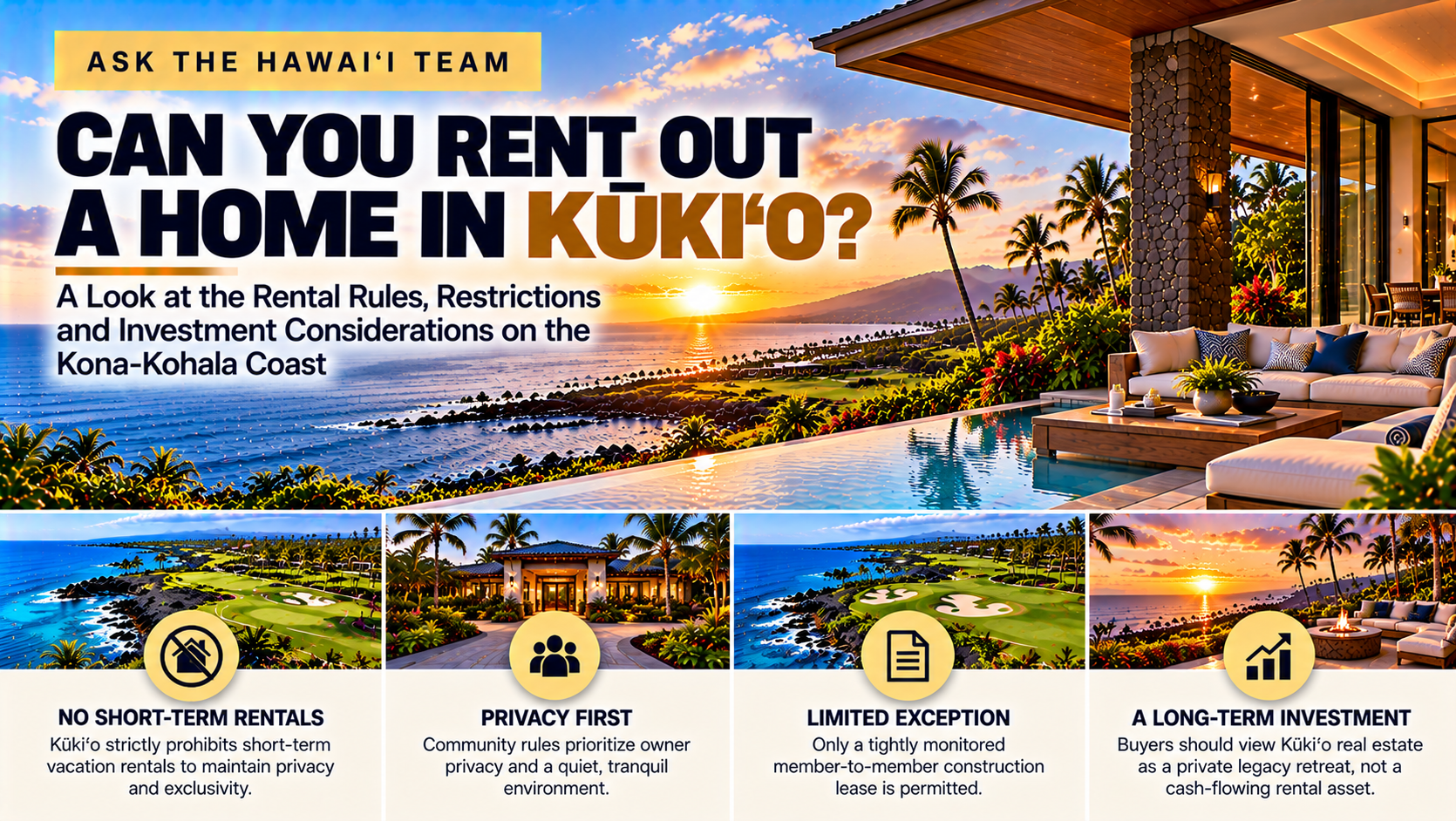
Quick Answer: No, Kūkiʻo strictly prohibits short-term vacation rentals to preserve privacy and exclusivity along the Kona-Kohala Coast. Long-term rentals are also heavily restricted, allowing only rare member-to-member construction leases under specific association guidelines.
Key Takeaways: Understanding Kūkiʻo Rental Restrictions
- Strict STVR Bans: Short-term vacation rentals are completely prohibited in Kūkiʻo and ultra-exclusive Kona-Kohala Coast communities like Hualālai Resort.
- Privacy First: Association rules prioritize owner privacy and community tranquility over passive investment returns.
- The Construction Exception: The sole rental allowance is a tightly monitored member-to-member lease for fellow members building a home within the community.
- Investment Reality: Buyers must view Kūkiʻo real estate as a private legacy retreat rather than a cash-flowing vacation rental asset.
Navigating luxury real estate restrictions along the Kona-Kohala Coast requires understanding strict community bylaws before committing capital. Here are the essential questions buyers and sellers are asking about rental rules in Kūkiʻo.
Can I Use My Kūkiʻo Second Home as a Short-Term Vacation Rental on the Kona-Kohala Coast?
More often than not, buyers entering the high-end Kona-Kohala Coast market assume that owning a multi-million-dollar property grants them the flexibility to offset costs through tourism. In Kūkiʻo, that assumption directly conflicts with community bylaws. Short-term vacation rentals are entirely prohibited within this ultra-exclusive enclave. The homeowners association explicitly bans transient lodging, meaning you cannot list your second home on standard platforms like Airbnb or VRBO. It is simply economics paired with a fierce dedication to security; the community was explicitly engineered as a private sanctuary rather than a revolving door for vacationers. When managing luxury assets through my specialized real estate systems, I always remind clients that Kūkiʻo guards its gates jealously. If your primary financial objective relies on generating weekly rental income to service a mortgage on your vacation rental, Kūkiʻo is not the right fit for your portfolio.
Why Do Ultra-Luxury Resorts Like Kūkiʻo and Mauna Lani Ban Vacation Rentals?
I would not be surprised to see strict anti-transient policies expand further along the Kona-Kohala Coast as high-net-worth buyers increasingly prioritize tranquility over commercial yield. Ultra-luxury enclaves like Kūkiʻo implement these rigid bans to protect the intimate lifestyle of resident families and club members. When hundreds of transient guests cycle through a neighborhood, it introduces security vulnerabilities, strains private club amenities, and disrupts the quiet serenity that defines these coastal sanctuaries. The homeowners association operates under the philosophy that a multi-million-dollar second home or luxury condo should serve as a generational retreat, not a commercial hotel alternative. By eliminating short-term traffic, property values remain insulated against the wear-and-tear typically associated with high-turnover tourism. Ultimately, the community board values an undisturbed environment above all else, ensuring that owners can enjoy pristine beaches and golf courses without the congestion plaguing other commercialized resort zones across the Hawaiian Islands.
Are Long-Term Rentals Ever Permitted for Luxury Properties in Kūkiʻo?
Long-term leasing faces nearly identical barriers to short-term options within this coastal sanctuary. Standard long-term residential tenancies—such as leasing your second home out to a non-member for a year—are heavily restricted or outright disallowed under the association’s governing documents. The overarching mission of Kūkiʻo is to maintain an intimate, owner-occupied ecosystem where everyone sharing the amenities belongs to the private club community. Allowing outside long-term tenants would dilute the exclusivity of the neighborhood and bypass crucial membership vetting processes. While other parts of the Kona-Kohala Coast offer flexibility for traditional landlords, Kūkiʻo maintains a closed-loop system. If an owner is not actively utilizing their estate, it typically sits vacant or is utilized exclusively by immediate family members. This strict adherence to occupancy rules safeguards the neighborhood’s unique character, ensuring that your neighbors are fellow stakeholders invested in the long-term stewardship of the land rather than temporary renters.
What Is the Member-to-Member Construction Lease Exception in Kūkiʻo?
The rules governing rentals in Kūkiʻo are rigid, but they do feature one very narrow exception designed for internal community logistics: the member-to-member construction lease. Let us say a fellow club member is currently building a new custom estate within the neighborhood and needs a temporary place to reside while construction is underway. Under association guidelines, that member may lease a completed home from another member within Kūkiʻo. This tightly regulated arrangement ensures that anyone occupying a residence during a transitional build phase is already vetted, approved, and embedded in the club culture. It is a practical workaround for internal community members, but it does not open the door to outside market leasing or passive income generation for regular investors. My advisory framework emphasizes that even within this lone exception, the transaction must navigate rigorous association oversight to guarantee compliance with internal community bylaws and privacy standards.
How Does the Lack of Rental Income Impact Second Home ROI on the Kona-Kohala Coast?
Evaluating return on investment on the Kona-Kohala Coast requires a complete shift in perspective when looking at non-rental communities like Kūkiʻo. Because short-term and long-term rental income streams are virtually nonexistent, your financial return cannot be measured through conventional cap rates or monthly rental yields. Instead, ROI is driven entirely by long-term capital appreciation, legacy preservation, and personal wellness dividends derived from utilizing world-class club amenities. Properties in Kūkiʻo have historically demonstrated robust appreciation due to severe inventory constraints and high global demand for ultra-exclusive Hawaiian real estate. Buyers must treat their acquisition as a trophy asset rather than an income-producing vacation rental or condo investment. When you remove rental revenue from the financial equation, the true value of ownership is realized through quiet mornings on private shores, pristine golf rounds, and generational enjoyment that transcends traditional market metrics.
The Bottom Line: Navigating Luxury Restrictions in Kūkiʻo
Investing in Kūkiʻo means fully embracing a lifestyle where privacy, exclusivity, and community tranquility supersede passive income potential. By understanding these rigid association bylaws upfront, buyers can align their financial expectations with the reality of owning an elite Kona-Kohala Coast legacy property.
“In Kūkiʻo, you aren’t buying a vacation rental asset; you are investing in an ultra-private legacy sanctuary where peace and exclusivity are the ultimate dividends.” — Dan Polimino
Frequently Asked Questions
Q: What are the rules on rentals in other Kona-Kohala Coast resorts like Hualālai and Mauna Kea? A: Hualālai Resort shares a similarly strict stance against short-term rentals, while other Kona-Kohala Coast resorts like Mauna Lani or Waikoloa Beach Resort offer designated pockets where vacation rentals are permitted. Always verify individual resort sub-association rules before purchasing.
Q: Can property management companies oversee a Kūkiʻo home while I am off-island? A: Yes, professional property management is common in Kūkiʻo for estate maintenance, security, landscaping, and concierge services, provided they do not facilitate unauthorized short-term or long-term rentals.
Q: How do Kūkiʻo’s HOA regulations protect property values over time? A: By completely banning transient tourism, the HOA minimizes community wear-and-tear and maintains a secure, ultra-private environment, which historically drives strong long-term capital appreciation for these rare Kona-Kohala Coast estates.